
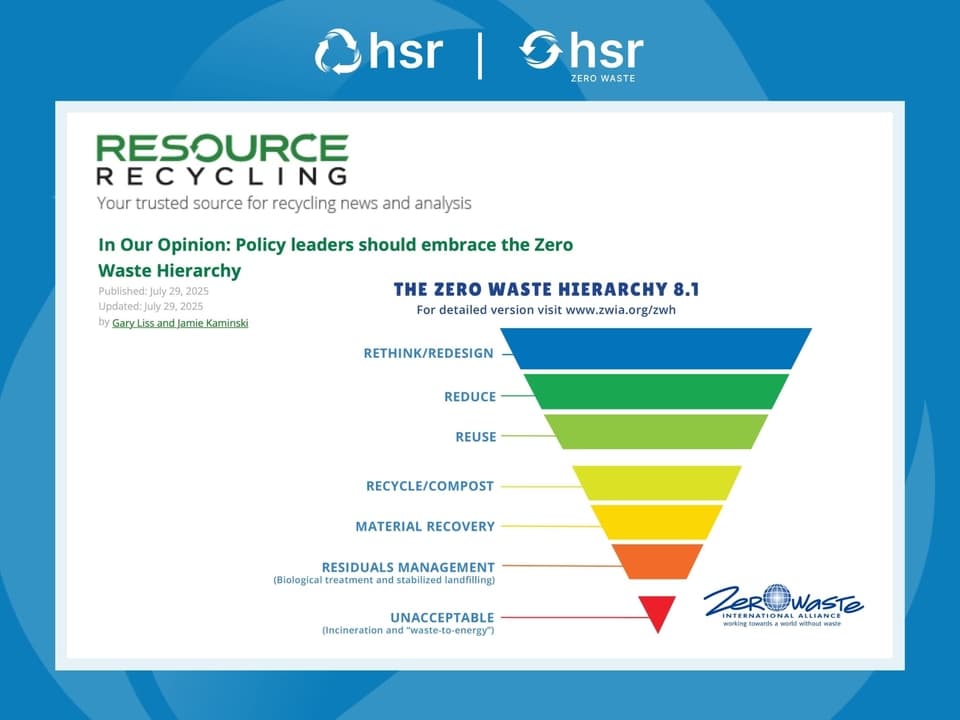
The recent op-ed co-authored by Jamie Kaminski, President of HSR Zero Waste, and Gary Liss, vice-chair of the Zero Waste International Alliance (ZWIA), in Resource Recycling magazine emphasizes the critical role of the Zero Waste Hierarchy in shaping sustainable waste management policies. Titled "In Our Opinion: Policy leaders should embrace the Zero Waste Hierarchy," the article serves as a pivotal call to action for policymakers to adopt this framework for more strategic environmental decisions.
The op-ed highlights the updated Zero Waste Hierarchy (Version 8.1), which introduces refined definitions, stronger ethical guidelines, and a renewed focus on prevention and equity. This version represents the culmination of global insights from zero-waste leaders, aiming to foster systemic change toward a circular economy. Kaminski's contribution underscores the collective effort of the zero-waste community in advocating for policies that prioritize upstream prevention and sustainable resource management.
Resource Recycling magazine, a leading publication in North America, provides a platform for such discussions, amplifying the message that the Zero Waste Hierarchy is not just a tool but a necessary foundation for environmental policy. The article encourages readers to explore the full op-ed on the Resource Recycling website or to learn more about the Zero Waste Hierarchy at zwia.org.
This publication marks a significant moment for HSR Zero Waste and the broader zero-waste movement as it seeks to influence policy leaders and institutions to embrace frameworks that ensure long-term environmental and economic benefits. The emphasis on prevention and equity within the Zero Waste Hierarchy reflects a growing consensus on the need for comprehensive strategies that address waste at its source, paving the way for a more sustainable future. The framework's updated version incorporates stronger ethical guidelines and refined definitions developed through global collaboration among zero-waste experts.
The advocacy for policy adoption of the Zero Waste Hierarchy represents a strategic shift toward upstream solutions that prevent waste generation rather than managing waste after it has been created. This approach aligns with circular economy principles that prioritize resource conservation and sustainable material flows. The involvement of established organizations like the Zero Waste International Alliance lends credibility to the framework and strengthens the case for its implementation across various policy domains.